How Music Is Integrated Into Every Owings Mills Early Learning Program
At Drool of Rock, music isn’t a subject we schedule once a week, it’s the language our classroom routines run on. From the moment a child arrives in the morning to the moment they’re picked up in the afternoon, music shapes how the day moves. Circle time opens with songs that settle the room and signal what’s coming next. Cleanup happens to a familiar tune that helps children shift from one activity to another without a struggle. Naptime winds down with quiet, predictable melodies that help even the most active toddler settle into rest. Outdoor play incorporates rhythm games and movement songs that build coordination alongside gross motor skills, and early language development is taught through call-and-response singing, rhyming, and phonics set to music rather than flashcards alone.
This is what makes an early learning program built around music different from a preschool that simply plays background music during free play or holds a weekly sing-along. Our lead teachers work side by side with professional musicians to design every transition, lesson, and daily routine so that music does real developmental work: building vocabulary, supporting emotional regulation, strengthening memory, and giving children a shared, joyful language they can use together as a class.

Because every age band learns differently, we’ve built a distinct, music-integrated approach for each stage of early childhood, from six-week-old infants through kindergarten-ready five-year-olds. Below, you’ll find an overview of what music integration looks like in each of our programs, followed by a look at the neighborhoods across the Owings Mills area families travel from to join us.
Infant Care (6 weeks–12 months)
For our youngest learners, music starts on day one. In our Infant Care program, caregivers use lullabies and gentle rhythm exposure to support the routines that matter most at this age: feeding, sleeping, and calm, secure bonding. Soft instrumental sounds and simple repeated melodies help infants recognize voices and patterns, which lays early groundwork for language development long before a baby says their first word.
Sensory play is also sound-based wherever possible. Shakers, soft drums, and textured instruments give infants a safe way to explore cause and effect while building the fine motor control they’ll rely on later. Tummy time, floor play, and one-on-one interaction are all woven with quiet singing and rhythm, so infants experience music not as entertainment but as a steady, comforting part of their earliest days away from home.
Every caregiver in our Infant Care classrooms is trained in music-based soothing techniques, and our low ratios mean each baby gets individual attention throughout the day. Learn about infant care
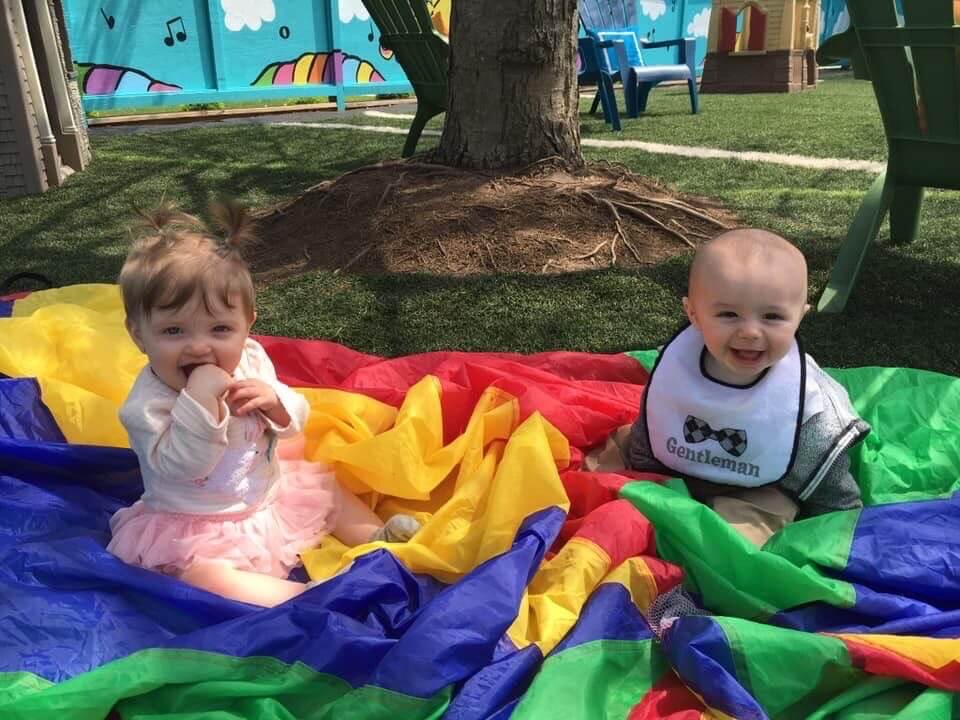
Toddler Care (12–24 months)
Toddlers are constantly moving, and our Toddler Care program channels that energy through music rather than fighting against it. Rhythm games help toddlers build body awareness: stomping, clapping, and marching to a beat strengthens coordination while teaching early concepts like fast/slow and loud/quiet in a way that feels like play, not instruction.
Songs also do heavy lifting for early language development at this age. Repetition-heavy tunes with simple, predictable lyrics help toddlers pick up new vocabulary and sentence patterns faster than speech alone, and call-and-response singing encourages toddlers to start using words and short phrases confidently. Group music time doubles as an early lesson in turn-taking and shared attention.
Our Toddler Care classrooms balance active, music-driven movement with quieter sensory and art activities, so toddlers get a full day that supports both their physical energy and their growing independence. Learn about toddler care
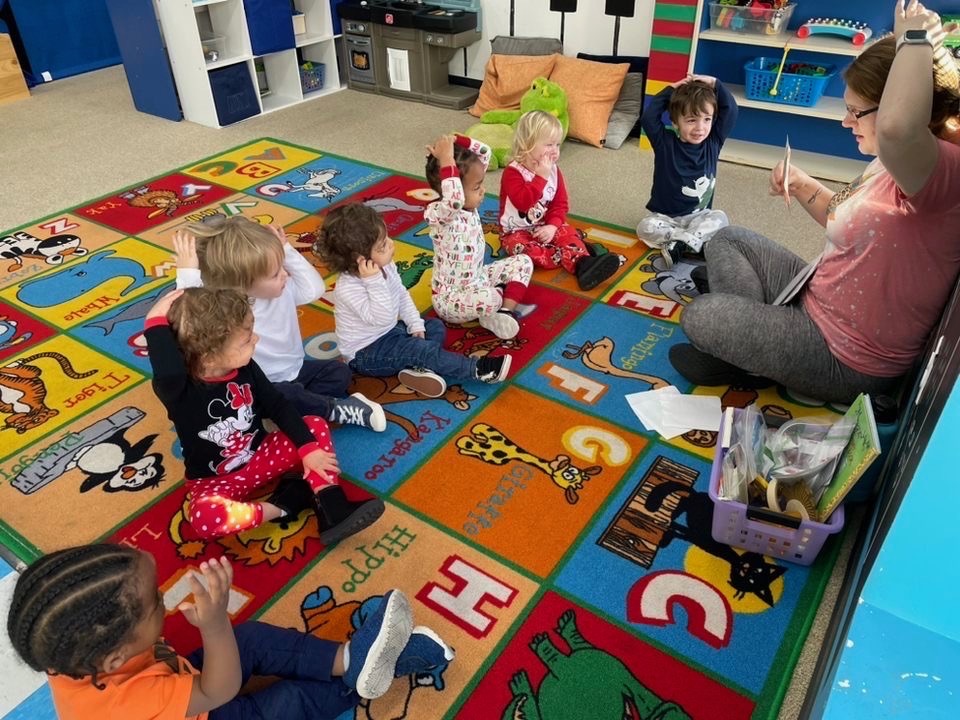
Preschool (2–4 years):
Our Music-Integrated Preschool in Owings Mills
By preschool age, music becomes a genuine teaching tool across every subject. Our music-integrated preschool in Owings Mills uses song-based phonics to introduce letter sounds and blending, so children build early reading skills through the same call-and-response singing they already enjoy. Rhythm-based math activities use clapping patterns, counting songs, and beat-keeping to introduce number sense, sequencing, and simple addition concepts well before children are ready for a worksheet.
Ensemble play, where children sing, play simple instruments, or move together as a group, does double duty as social-emotional learning. Preschoolers practice listening to each other, waiting for a turn, and contributing to something bigger than themselves. Teachers use music to redirect big emotions too: a calming song can settle a frustrated preschooler faster than words alone.
Our full kindergarten-readiness curriculum is detailed on our Daycare Curriculum page.
See our preschool curriculum
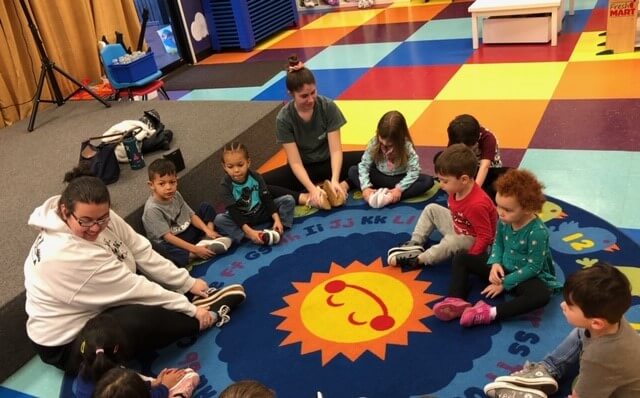
Pre-K & Kindergarten Readiness (4–5 years)
Our Pre-K & Kindergarten Readiness program takes everything children have built in earlier programs and sharpens it for the transition to kindergarten. Letters are taught through song-based phonics and phonemic awareness games. Math concepts, patterns, sequencing, early addition and subtraction, are taught through rhythm and beat-keeping, giving children a concrete, physical way to understand abstract number relationships.
Problem-solving is practiced through ensemble activities: figuring out how to fit a part into a group song, adjusting when a rhythm changes, or working out a simple percussion arrangement with classmates. We also focus on the practical side of kindergarten readiness: following multi-step directions, managing personal belongings, and building the stamina for a full school day.
Pre-K & kindergarten readiness
Neighborhoods We Serve
Families travel to our Owings Mills location, at 10 Easter Court Ste C, from across the surrounding area. We’re proud to serve children and families from Owings Mills itself, along with neighboring communities including Pikesville, Reisterstown, Lutherville, McDonogh, Garrison, Randallstown, and Mays Chapel. We also operate a second location in Cockeysville, Maryland, for families who find that campus more convenient.
As we continue to grow, we’re building dedicated neighborhood pages so families in each community can find specific details about commute times and what to expect when they visit. Those pages are on the way; in the meantime, families from any of the communities above are welcome to schedule a tour and ask our team any questions about commuting, drop-off, or scheduling.
Testimonials Singing our Praises
Our curriculum comes to life through the experiences of the families we serve. Here’s what parents from Owings Mills and surrounding communities have to say about their children’s growth, confidence, and love of learning at Drool of Rock.
I love this place!
There is not a more colorful, musical environment available for young children in this area. Having taught preschool for 30 years, and performed for young children for all of those years I’ve seen many, many child care centers, schools, camps and venues. None of them provide the daily musical experience, let alone professional musicians, at the level D.O.R does. There is, more importantly, an outstanding, caring staff with plenty of experience. The enclosed (walled) outdoor play area, which provides some cover on rainy days, is extremely safe. I love this place!

I am thrilled with the program!
I love the energy and enthusiasm at Drool of Rock. My child is a very active, passionate, and social being. These are all things that are fostered at Drool of Rock. My child has made new friends, sings new songs, dances new dances and is tired at the end of the day. Counting to twenty in Spanish and writing letters. I am thrilled with the program!
We LOVE Drool of Rock!
We LOVE Drool of Rock! Our son had an in-home nanny for his first 3 years and we were very worried about how he would adjust to preschool. The staff and children were so incredibly welcoming which helped him transition beautifully. It is a fun, engaging learning environment with caring and competent teachers. Our son loves the music and art focus and it is artfully decorated to support the theme – not dark at all – in fact extremely bright and colorful. As a former early childhood educator who has seen many, many daycare centers and preschools – I do believe this is a top notch preschool environment and would recommend it.
Our Rockin’ Daycare Locations
Families can choose the Drool of Rock location that best fits their commute and schedule, while enjoying the same engaging curriculum and caring environment at each center.