
If your child hums a made-up tune while stacking blocks, you have already seen what a play based learning preschool does on purpose, every day. Play and music are not separate activities squeezed into a schedule, they are the same developmental engine, running on the same fuel: curiosity. At Drool of Rock, we build our days around that engine, blending open-ended play with musician-led exploration so children build language, coordination, and confidence without ever feeling like they are “working.” Here is what the research says about play-based learning, why music strengthens it, and what it actually looks like inside our Owings Mills classrooms.
Play-Based Learning Preschool, Defined
Play-based learning is not the same as unstructured free time. It is a deliberate teaching approach in which trained educators design the environment, the materials, the room layout, the daily rhythm, so that children learn core skills through play rather than direct instruction. The National Association for the Education of Young Children (NAEYC) frames this as developmentally appropriate practice: teaching that meets children where they are cognitively, socially, and emotionally, rather than pushing academic content down from older grade levels.
In a NAEYC-aligned classroom, teachers rotate between roles. Sometimes they observe quietly, taking notes on how a child sorts blocks by color. Sometimes they join the play, asking an open-ended question that nudges a child toward a new idea. Sometimes they step back entirely and let two children negotiate whose turn it is with the puppet theater. Every one of those moments is intentional, even though it looks like ordinary play from the doorway.
This is the distinction families should look for when touring a preschool: does play happen because there is nothing else scheduled, or does play happen because the teachers designed it as the primary vehicle for learning? The second is play-based learning, and it is backed by decades of child development research.
Montessori vs. Play-Based Learning: What’s the Difference?
Families often ask how play-based programs compare to Montessori, since both put the child, not the worksheet, at the center of the day. The overlap is real: both approaches trust children to direct much of their own learning, both favor hands-on materials over lectures, and both treat independence as a skill worth building early.
Where they diverge is in structure. Montessori classrooms are built around a specific, sequenced set of materials, and children choose their “work” from a defined shelf, often in extended, uninterrupted stretches of solo concentration. Play-based classrooms, like ours, lean toward a wider variety of open-ended materials and more teacher-facilitated group play, with children rotating through centers and collaborating more frequently in pairs or small groups. Neither approach is more rigorous than the other. They simply organize a child’s independence differently, and families should choose based on which rhythm fits their child’s temperament.
The Research Behind Play-Based Learning
The case for play-based learning is not anecdotal. It is one of the more heavily studied areas in early childhood education. The Center on the Developing Child at Harvard University has published extensively on how young children build cognitive and self-regulation skills through active, playful engagement with caregivers and peers, describing play as a primary mechanism for building the brain’s executive function circuitry, the skills children rely on to plan, focus attention, and manage impulses.
NAEYC’s own research summaries echo this finding, noting that play supports language development, social negotiation, problem-solving, and emotional regulation simultaneously, in ways that isolated academic drills typically do not. When a child negotiates roles in pretend play like, “you be the customer, I’ll be the baker” they are practicing perspective-taking, vocabulary, sequencing, and conflict resolution all at once.
Longitudinal studies on early childhood programs have also found that children in play-rich, developmentally appropriate classrooms tend to show stronger self-regulation and social skills later in elementary school compared with peers in highly didactic, worksheet-heavy programs, even when early academic scores looked similar in kindergarten. The advantage shows up less in rote knowledge and more in the skills that predict long-term school success: the ability to sit with frustration, collaborate with a partner, and stay engaged with a task.
None of this means academics do not matter. It means the research consistently points to play as the delivery mechanism, not the distraction, for building the skills that make later academic learning possible.
How Music Amplifies Play-Based Learning
Music is one of the most effective ways to deepen play-based learning, because it adds structure, repetition, and joy without adding pressure. A rhythm game is still play, but it is play that happens to be training a child’s auditory discrimination, timing, and memory at the same time.
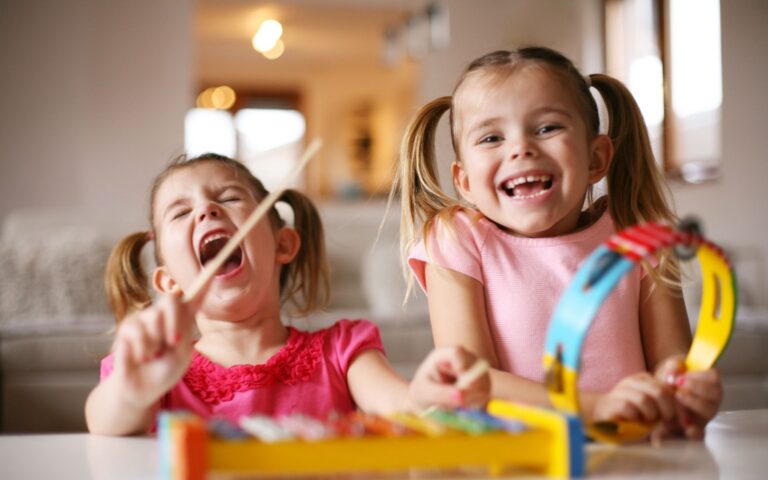
Rhythm-based games are a good example. When children pass a beat around a circle or echo a clapping pattern, they are practicing sequencing and working memory, skills that transfer directly to early literacy, since reading also depends on processing sounds in order. Ensemble play, even simple instrument circles with shakers, drums, and bells, teaches turn-taking and group listening in a way that feels like celebration rather than a rule to follow.
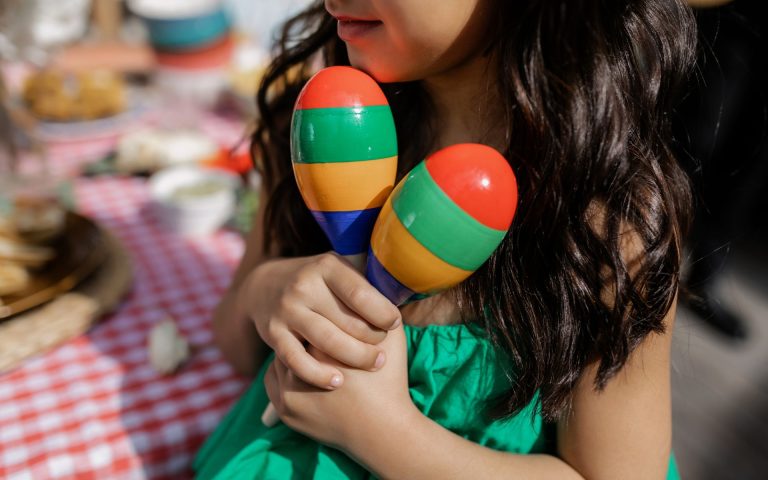
Musical exploration also gives children a low-stakes way to experiment. There is no wrong way to shake a maraca or bang a drum, which makes instruments an ideal entry point for reluctant or anxious children who might hesitate to speak up in a more academic setting. That freedom to explore without fear of a “wrong answer” is exactly the emotional safety that play-based philosophy is built on.
Instrument-driven imagination takes this further. A cardboard box becomes a drum; a scarf becomes a scene for a song about the ocean. Music gives children a vocabulary of sound and movement to layer onto their pretend play, which expands both their creative range and their working memory for sequences, patterns, and stories. This is the specific intersection where Drool of Rock spends most of its energy: not music lessons bolted onto a daycare schedule, but music woven into the same open-ended play that already builds language and social skills.
What Play-Based Learning Looks Like in an Owings Mills Daycare
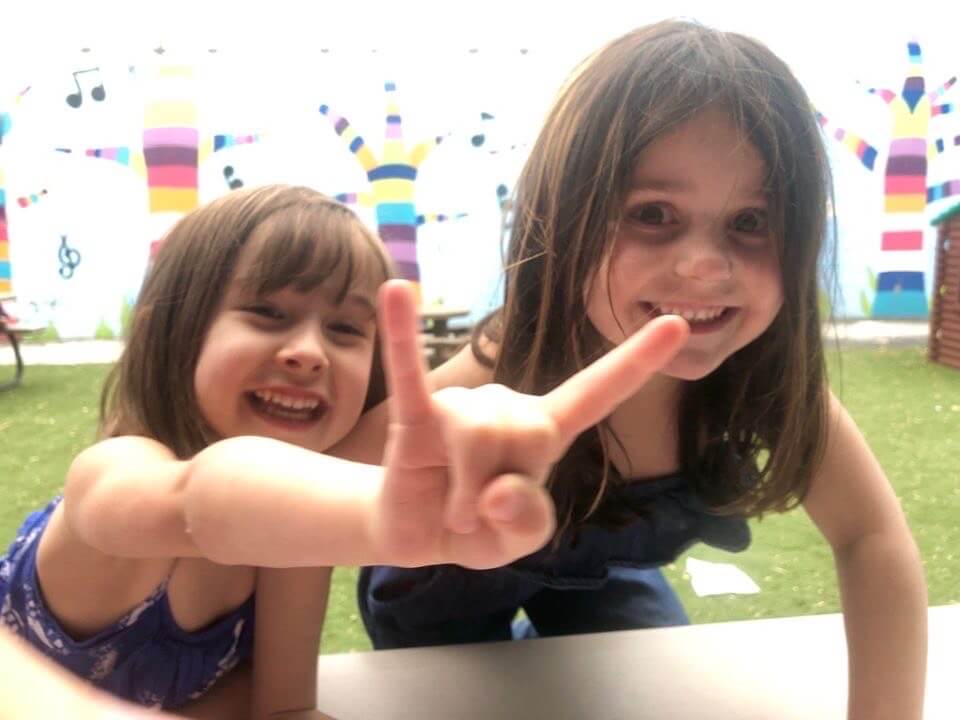
Walk into a Drool of Rock classroom on a Tuesday morning and you will not see rows of desks. You will see a music corner with shakers and a small keyboard, a block area mid-construction, and a rug where three children are working out the plot of a puppet show involving a dragon and a very confused firefighter.
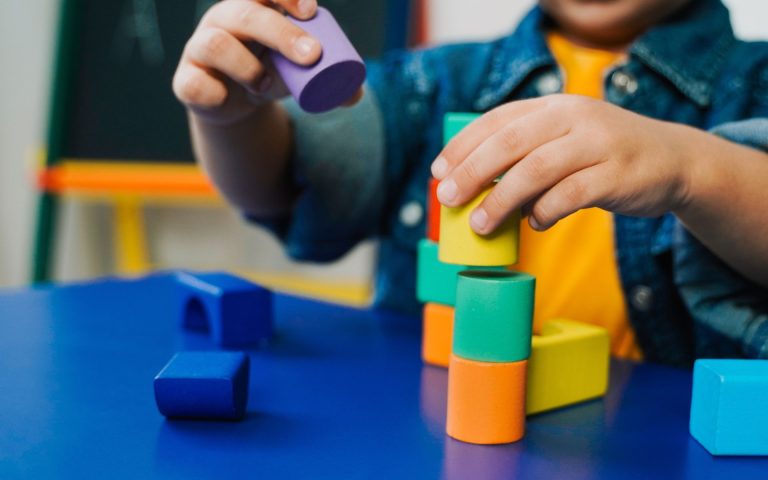
Our daily routine is built around blocks of child-led center time, punctuated by short, musician-led group sessions. During centers, children choose where to play: dramatic play, blocks, art, or the music table, and teachers move between areas, asking questions and extending ideas rather than directing them. A child stacking blocks into a “castle” might get a gentle nudge, “What sound would the castle make if the wind blew through it?” that turns a building exercise into a sound exploration.
Group music sessions happen a few times a day in short bursts, led by a musician on staff rather than a classroom teacher reading from a curriculum binder. These sessions use call-and-response singing, simple percussion, and movement games tied to whatever theme the classroom is exploring that week, whether it is ocean animals, community helpers, or the seasons.
Outdoor time and movement breaks are treated as core curriculum, not a reward for finishing work, because gross motor play supports the same self-regulation skills as quiet play. By the end of the day, a child has moved through pretend play, construction play, music, art, and outdoor play, each one reinforcing language, coordination, and social skills from a different angle, all without a worksheet in sight.
Play-Based vs. Academic Preschool: Which Is Right for Your Family
Some families thrive with a more academic, direct-instruction preschool model, and it is worth being honest about the tradeoffs rather than pretending one model is right for everyone.
Academic-style preschools tend to emphasize letter recognition, counting, and structured seatwork earlier, which can feel reassuring to parents who want visible, measurable progress. This approach can work well for children who enjoy structure and repetition, and some go on to transition smoothly into traditional elementary classrooms.
Play-based programs, by contrast, build the same academic foundations, letters, numbers, early reasoning, but embed them inside play rather than teaching them in isolation. The tradeoff is that progress is less visible on a flashcard and more visible in behavior: a child who can wait their turn, negotiate a disagreement, or stick with a hard puzzle for ten minutes.
A useful question to ask on a tour is not “which is better” but “which matches how my child already learns best.” A child who lights up during pretend play, music, and hands-on exploration will likely thrive in a play-based, NAEYC-aligned environment like Drool of Rock, where music is used as a daily tool for building exactly the skills, language, sequencing, self-regulation, social negotiation, that carry into kindergarten and beyond.
Frequently Asked Questions
Ready to see play-based learning and music in action? Tour Drool of Rock and watch a class for yourself. For more on the research behind play, see NAEYC’s play research.