
If you are planning for your child’s 2026 preschool year in Maryland, you might be wondering what is free, what has a fee, and how to secure a spot that fits your family’s schedule. We put this guide together to make the landscape clear, from public Pre-K eligibility to typical tuition ranges, and how a music-first program can bridge gaps and boost readiness. You will also find next steps to connect with our Owings Mills and Cockeysville teams for tours and support.
The short answer to Is preschool free in Maryland?
Public school Pre-K in Maryland can be free for many families, but not all. Maryland expanded access to publicly funded Pre-K, and local school systems offer:
- Free full-day or half-day Pre-K seats for children who qualify based on income or specific needs.
- Additional Pre-K slots on a sliding scale when funding allows.
- Community provider partnerships in some districts, where publicly funded Pre-K is delivered in approved private settings.
Eligibility and funding vary by county, and seats are limited. Your child’s age, your household income, and your local school system’s capacity determine if you receive a free seat, a reduced-tuition seat, or if you are offered tuition-based preschool.
Key points for 2026:
- Age cutoffs: Most districts require your child to be 4 years old by September 1 for Pre-K 4, and some offer Pre-K 3 for children who turn 3 by September 1.
- Priority: Children from low- to moderate-income households, English learners, and children with documented needs are prioritized.
- Proof: You will submit documentation during application season, which typically opens late winter or early spring for the fall start.
Tip, check your county’s public school website for Pre-K eligibility and application windows, and set calendar reminders, since seats often fill quickly.
What is the average cost of preschool in Maryland?
When a family does not receive a free or sliding-scale public Pre-K seat, preschool costs vary widely. Averages shift by region, schedule, and program features, but here is a practical range to help you budget:
- Part-time preschool, 2 to 3 half-days per week, can range from roughly $250 to $600 per month.
- Part-time preschool, 5 half-days per week, often runs $500 to $900 per month.
- Full-time preschool or childcare with a preschool curriculum can range from approximately $1,100 to $1,900 per month, with higher-end programs sometimes above that range in metro areas.
These estimates are directional, not quotes. Tuition depends on your child’s age, hours, teacher ratios, enrichment offerings, and whether meals or supplies are included. Always ask about registration fees, supply fees, and any discounts for siblings.
Is preschool cheaper than daycare?
Sometimes, but it depends on the schedule you need. School-district Pre-K is typically free or reduced for eligible families, yet it usually follows a school-day calendar and does not include full-day, year-round care. Many parents still need wraparound hours before and after the Pre-K day, plus coverage during school breaks.
- If you need only a short morning program, preschool can be cheaper than full-time daycare.
- If you need consistent full-day, year-round care, a full-time program that blends preschool learning with childcare can be more cost-effective than piecing together half-day preschool and separate wraparound care.
- If you receive a free public Pre-K seat, you might still pay for wrap care or summer coverage.
In other words, the cheaper option is the one that truly fits your daily rhythm, commute, and work schedule.
Public Pre-K vs. private preschool, how to choose for 2026
Start with the questions below, then compare programs in your neighborhood.
- Eligibility: Are you likely to qualify for a free or sliding-scale public Pre-K seat?
- Hours: Do you need early drop-off, late pickup, or year-round coverage?
- Class size: What are the ratios and group sizes?
- Curriculum: How does the program support language, motor skills, social-emotional growth, and kindergarten readiness?
- Transitions: How will your child be supported during drop-off and at key milestones?
If you plan for public Pre-K, ask about transportation, wrap care, and summer offerings. If you choose a private or community program, ask about tuition, schedule flexibility, and how learning is integrated throughout the day.
How our music-first approach bridges gaps and boosts readiness
At Drool of Rock, we serve children from 6 weeks to 5 years with a musician-led, play-based curriculum. Whether you are waiting for a public Pre-K decision, need full-day continuity, or want a warm preschool where your child learns through music and movement, we are here to help.
Our daily flow includes:
- Circle time with call-and-response singing to build language, listening, and memory.
- Movement and dance for balance, coordination, and body awareness.
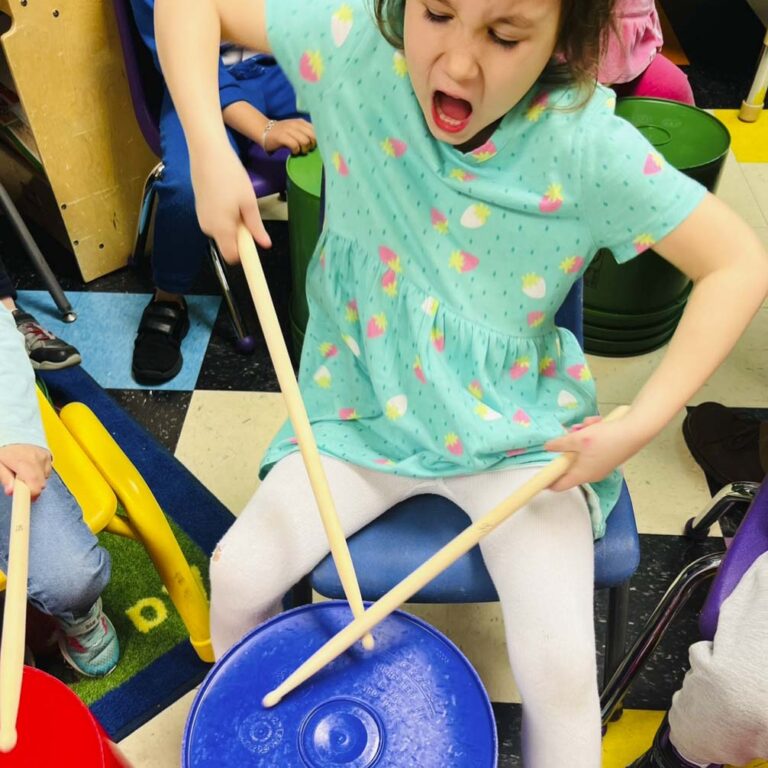
- Instrument exploration with shakers, rhythm sticks, and drums to strengthen fine motor skills and patterning.
- Early literacy and math embedded in songs, chants, counting beats, and simple patterns.
- Art and manipulatives to encourage creativity and hand-eye coordination.
- Outdoor music play to practice self-regulation and social skills in a joyful way.
Music ties it all together. It has been repeatedly shown to support attention, working memory, early numeracy, and emotional regulation, which makes transitions smoother and learning stickier.
Part-time vs. full-time, how we support your family
Every family’s schedule is different. We help you weigh:
- Part-time options for children easing into group settings.
- Full-time care that pairs a year-round preschool curriculum with consistent routines and social practice.
- Transitional support when your child moves from toddler rooms to preschool rooms or from preschool into public Pre-K.
We keep you connected with regular photo and message updates, so you can see your child’s progress, new skills, and friendships in action. Families tell us drop-off is easier when children are excited for music time, and that confidence carries into kindergarten.
Enrollment steps and timing for 2026
Here is a simple path to plan your year:
- Check your county’s Pre-K eligibility and note application dates.
- Tour community programs early, ideally winter through spring.
- Ask about waitlists, start dates, and wrap care needs for public Pre-K.
- Gather documents, birth certificate, proof of residency, and income verification if applying for public seats.
- Decide on part-time or full-time coverage for summer and school breaks.
If you want a supportive, music-rich environment while you confirm public options, or you prefer a consistent full-day program, we would love to meet you. You can explore our rooms, outdoor spaces, and daily flow, and we will answer all your questions about schedules and readiness.
Visit us in Owings Mills or Cockeysville
Families from Owings Mills, Cockeysville, Timonium, Towson, Pikesville, Reisterstown, Randallstown, and nearby communities are welcome to tour. Our musician-led teams are ready to show you how joyful learning can be.
- See our daycare curriculum in action, singing, instruments, movement, art, and outdoor play, and how it builds language, motor, and social-emotional growth.
- Ask about transitions, photos and messaging, and how we scaffold independence.
- Share your schedule needs, we will help you map part-time or full-time coverage around public Pre-K.
If you are thinking about 2026, reach out early. You can start the conversation and request a tour on our site. For a direct next step, explore pre-k enrollment to get a feel for timing and availability. If Owings Mills is your home base, you can also browse daycare in owings mills to see programs and location details. And if you are comparing local options, families often search for daycare owings mills when they want a quick view of hours, rooms, and contact info.
The bottom line
- Public Pre-K in Maryland can be free for eligible families, and some seats are sliding scale, but availability and hours vary by district.
- Average preschool costs range from a few hundred dollars monthly for part-time to around $1,100 to $1,900 or more for full-time care, depending on features and location.
- Preschool can be cheaper than daycare if you only need short hours, while full-time, year-round needs are often better served by an integrated program.
We are here to help you chart the best fit for your child and your schedule. Contact our Owings Mills or Cockeysville teams to tour, talk through 2026 timelines, and see how a music-first classroom nurtures confidence, curiosity, and kindergarten readiness. For those about to rock, we salute your planning and we are excited to welcome your family.